Guide to Iowa Marriage Records
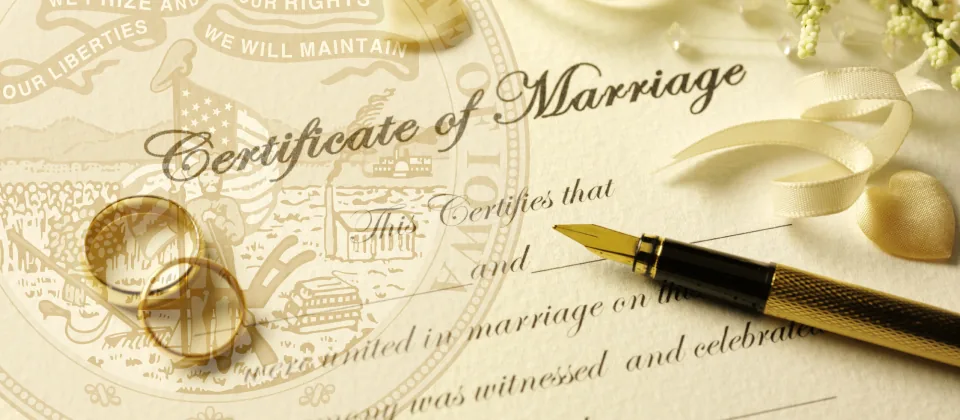
Marriage records in Iowa are official documents that reference the legal union of two individuals. They allow people to prove their identities and trace family roots. Iowa marriage records include details such as both spouses' names, the date and place of the wedding, the officiant's name, and the names of the spouses' parents.
Although people often confuse the terms “marriage license,” “marriage record,” and “marriage certificate,” they denote different things. A marriage license is an authorization granted by the state to marry; a marriage certificate is a formal marriage document signed when a person gets married; and marriage records are the state's permanent master files that contain all documents related to a marriage.
Typically, individuals search marriage records for legal reasons, including updating their identities with government agencies after marriage and proving marital status in divorce or estate matters.
Types of Marriage Records in Iowa
| Record Type | Purpose | Issued By | Validity/Notes |
|---|---|---|---|
| Marriage License | Grants legal permission for a couple to marry. | County recorder or registrar. | Valid starting 3 business days after issuance, but expires after 6 months. |
| Marriage Certificate | Proves that a marriage legally took place. | County Registrar and Iowa HHS Bureau of Health Statistics. | A certified copy can be used for federal and state legal actions. |
| Historical Marriage Records | Documents marriages for family history research. | State Historical Society of Iowa, State Archives, county repositories, and partner databases. | Marriage records in the State Archives’ custody become publicly available when they are 75 years old or older. |
Iowa marriage records are commonly available in the following forms:
Marriage Certificates
A marriage certificate is proof that a marriage legally took place and was registered in Iowa. It contains details like the following:
- Spouses' full names
- Marriage date
- County where the license was issued
- Filing date
An Iowa marriage certificate may be issued as an informational or certified copy. A certified copy bears an official seal or raised stamp and is required whenever a marriage certificate is needed for legal purposes, such as a name change, visa application, or court filing. A plain copy is not accepted for these purposes.
Certified copies can be issued by the county recorder in the county where the license was obtained or by the Iowa Department of Health and Human Services (HHS) Bureau of Vital Records for records available at the state level.
Marriage Licenses
An Iowa marriage license is the authorization a couple must obtain from the state before their wedding ceremony can legally take place. A marriage certificate, by contrast, is proof that the wedding occurred.
Iowa marriage licenses are issued by the county recorder or registrar's office. Once issued, a marriage license does not take effect immediately, as Iowa imposes a three-business-day waiting period before the marriage may be performed. After this waiting period, the license remains valid for six months.
Are Marriage Records Public in Iowa?
Iowa marriage records maintained at the state level by the HHS are closed to the public. Anyone seeking to obtain a certified state copy must establish the required direct and tangible interest in the record.
However, under state law, marriage records held by a county registrar may generally be inspected by the public per the state's public records law after confidential information has been removed.
Marriage record age affects access in Iowa. Marriage records for individuals aged 75 or older are publicly accessible without proof of entitlement.
What Information Is Included in a Marriage Record?

An Iowa marriage record provides details, including:
- Full names of both parties (including birth surnames or previous names)
- Age, birth dates, and birthplaces of the spouses
- Residential addresses at the time of application
- Full names of both spouses' parents (including mothers' maiden names) and their birthplaces
- Date and county or city location of the marriage ceremony
- Signatures of the couple, their adult witnesses, and the authorized officiant.
Although all information obtained during the marriage-license application becomes part of the marriage record, not all details collected during this process are publicly available. Iowa vital record registrars are required to remove information considered statistical or confidential before allowing public inspection.
For example, Social Security numbers and other legally confidential information cannot be released through an ordinary public inspection. Records sealed by a court or a state registrar are also restricted. Hence, even certified copies do not contain any confidential information.
How to Find Marriage Records in Iowa
Step 1: Identify the Marriage Details
Gather the necessary identifiers for the event before initiating the search, including both partners' full legal names, the approximate date of marriage (a calendar date or year), and the specific Iowa county or city where the couple obtained their marriage license.
Step 2: Find the Record Custodian
The next step is to identify the appropriate custodian for the record you need. The Iowa HHS Vital Records Bureau maintains a master index of all the marriages filed statewide from July 1, 1880. However, county recorders maintain local registries.
Note that all marriages that occurred between 1921 and 1941 can only be found at the state level, and marriages from 1954 to the present can be accessed electronically via county recorder systems.
Step 3: Choose How to Search
Several options are available for requesters seeking Iowa marriage records. These include the following:
- Online: Historical Iowa marriage records can be searched through FamilySearch or Ancestry, while some counties offer online search systems for marriage indexes.
- By mail: Submit a completed application form to Iowa HHS or to the appropriate county recorder, depending on the custodian of the recorder.
- In person: County offices offer in-person services for visitors requesting marriage records.
- Through approved third-party databases: Iowa partners with VitalChek, a third-party, to offer requesters access to marriage records.
Step 4: Submit a Record Request
A certified copy request must contain information on the record being requested, as well as any documentation needed to demonstrate that you are eligible to obtain the records.
Iowa requires a complete application, purpose for requesting the records, proof of the relationship to the individual named in the record, identification, and any additional documents necessary to establish eligibility to obtain the record. Mailed applications must be notarized and include a clear copy of your current government-issued ID photo.
The state and county search fee for a marriage record is $20. If the record is found, you will receive a certified copy. If the record is not found, Iowa will provide a notification letter and retain the $20 fee.
Iowa HHS currently lists two hours for all qualifying requests received in person by 2 p.m. and four to six weeks for records requested by regular mail. VitalChek processing varies by the selected service option and includes a vendor fee.
How to Get a Certified Marriage Certificate in Iowa
The state of Iowa issues certified vital records to individuals who have a direct, tangible interest in the record. This includes individuals whose names appear on the record, immediate family members, and others with documentation demonstrating their authority over the individual whose records are requested.
All applicants for Iowa vital records must provide valid government-issued photo identification. If a marriage record is requested by mail, the applicant must submit a photocopy of their identification along with a notarized application.
Standard fees for requesting certified copies are $20 for each requested record search. The fee is nonrefundable even if no documentation is found.
Requests can be made:
- In person: At the Iowa HHS Bureau of Health Statistics in Des Moines. Requests received by 2 p.m. are generally processed within about two hours.
- By mail: Submit the notarized application, photo-ID copy, and $20 fee. Iowa lists an average processing period of about four to six weeks.
- Online: Use VitalChek, Iowa HHS's authorized vendor. The $20 state fee applies, together with the vendor's additional charges.
- By phone: Orders can also be placed through VitalChek.
- Through a county recorder: County recorders can provide certified copies, subject to Iowa's record-availability and entitlement rules.
A certified marriage certificate can serve as legal proof of marriage and may be required for name changes, passports, government ID cards, benefits, insurance, pension purposes, and other legal transactions.
How to Get a Marriage License in Iowa
Marriage licenses in Iowa are issued by county recorders or county registrars. Hence, an application for an Iowa marriage license can be filed at the office of any county registrar and used anywhere in the state to get married. There is no state residency requirement in Iowa, and each county provides procedures for out-of-state applicants to follow when applying for a marriage license.
Iowa sets age restrictions for marriage license applicants. Individuals over the age of 18 can independently apply for a marriage license without parental consent. However, a person aged 16 or 17 must obtain parental consent and court approval. No one under the age of 15 can enter into a marriage in Iowa.
The application process for an Iowa marriage license generally requires that both applicants complete the required affidavit and that a competent adult familiar with both applicants serve as a witness. Government-issued photo identification must be presented at the county office at the time of the application, and signatures must be notarized if the application is not completed at the recorder’s office.
Iowa allows for a marriage license application or a statutory fee of $35. This application fee includes certified copies of the marriage certificate once the requirements have been met and the certificate has been filed.
After the application is filed, applicants must wait three calendar days for the marriage license to become valid. The date of application does not count. However, a judge can waive this waiting period for an emergency or other special reason. Note that the statutory waiver application fee is $5 unless waived because an applicant cannot pay.
After the application process, the marriage license remains valid for 6 months from the date it becomes usable.
For the marriage ceremony, Iowa requires the couple, the officiant, and two witnesses to be physically present at the same time and place. No proxy marriages, telephone marriages, or electronic marriage ceremonies are allowed.
Iowa marriage ceremonies must be solemnized by an authorized Iowa judge or magistrate or by an individual ordained or designated as a leader of that person's religious faith. After the marriage ceremony, the spouses, the two adult witnesses, and the officiant must sign the marriage certificate. Then, the officiant must return the certificate to the issuing county registrar for registration within 15 days.
Who Can Request Marriage Records?
Access to certified marriage records under 75 years old is legally restricted to protect personal privacy. The individuals allowed to make requests are:
- Either individual named directly on the marriage record.
- The current legal spouse of either party.
- Biological or legally adoptive parents, grandparents, and grandchildren.
- Children or siblings of the individuals on the record.
- A legal representative, attorney, or guardian (who must supply court documentation or proof of entitlement)
Per state law, third-party requesters or individuals without a direct relationship to the persons named on the record are generally not eligible to obtain certified copies of recent marriage records.
However, members of the public may obtain historical records aged 75 years or older.
Free and Online Marriage Record Searches

Iowa does not provide a statewide online system to obtain certified marriage records for free. Records maintained by the Iowa HHS are not open to public inspection and cost $20 to perform an official state marriage record search.
However, there are a few options for accessing historical records. For instance, the State Historical Society of Iowa partners with genealogical databases like FamilySearch and Ancestry to provide free online access to portions of its marriage index collections. FamilySearch can be used free from home, and both FamilySearch and Ancestry are available without charge at the Historical Society's Des Moines and Iowa City research centers.
If the exact date or county of a marriage record is unknown, searchers may begin with the full name of one spouse and the approximate marriage year. They may also try the premarital surname and later surnames (if applicable and known), then use locations where either spouse previously resided to narrow the likely county.
Note that free historical indexes may be used to find a marriage or research it; however, they cannot be used to obtain official certified marriage records when proof of marriage is required by a state agency, court, or insurance company.
Common Law Marriage in Iowa
Iowa remains one of the few states to recognize common-law marriages. Legal recognition of a common-law marriage in the Hawkeye State is founded on a couple meeting the following conditions:
- A clear, continuous intent and agreement to be married
- Continuous cohabitation as spouses
- “Holding themselves out” publicly to the community as a married couple (such as filing joint taxes or sharing a last name).
Note that Iowa recognizes common-law marriages legally established in other states before moving there.
Since no traditional marriage licenses were issued for solemnization, common-law marriages do not generate standard vital public records or marriage certificates. Hence, couples in common-law marriages must rely on affidavits or court declarations to verify their marital status for insurance or estate purposes.
How to Correct an Error on a Marriage Record
Iowa marriage records may contain errors such as incorrect dates of birth, birth locations, parents' names, or typographical errors.
Amendments to a certificate of marriage during the first year may be made by the county registrar who issued the license to marry. Beyond that period, an amendment may be requested by a spouse named on the record mentioned in the marriage certificate. The applicant must complete the Amendment to Iowa Certificate of Marriage application and have it notarized.
Supporting the application, the applicant may be required to submit additional documents. Depending on the nature of the amendment, these documents may include a certified birth certificate, a military record, an employment record, an educational record, an insurance or pension document, or a medical record.
The complete application, along with supporting documents, must be submitted to the Iowa HHS Bureau of Health Statistics. Correction requests attract an administrative fee of $15 per request. If the applicant also requires a certified copy of the amended record, an additional $20 fee will apply.
Processing times for amendment requests vary with the nature of the amendment. Usually, straightforward amendments are completed within 15 days, while complex ones may take between four and six weeks.
Marriage Records and Name Changes
Marriage documentation has important legal implications for name changes. According to Iowa Code §595.5, couples may indicate their preferred legal names on the marriage license application after marriage. If the names are specified on the application, the spouses will be legally known by these identities after marriage.
Hence, a marriage certificate can be used as proof linking a previous name and a new name. The Social Security Administration (SSA) requests the certified marriage certificate as official evidence of a legal name change. Additionally, the Iowa Department of Transportation requires a certified marriage certificate before implementing a marriage-based name change on its records. Similarly, the U.S. Department of State may request a certified marriage certificate for a name change on a passport.
However, changing a legal name on a government database due to a marriage-based name alteration is different from correcting the marriage record itself. If there is an error on a marriage record, either spouse named on the record must file an amendment request to the HHS Bureau of Vital Statistics.
Marriage Records for Genealogy and Family History
In Iowa, the recording of vital events began at the county level in 1880, and consequently, a comprehensive collection of historical marriage records is available to researchers in the state. Older marriage records are important for genealogists tracing Iowa ancestry.
The State Historical Society archives preserve files for pre-1940 marriages. However, the years of preserving these documents can differ from county to county. The research centers of the State Historical Society also maintain state-level marriage records from 1833 to 1937.
There are a few online resources for conducting searches of historical marriage records. For instance, FamilySearch has a collection of marriage records from 1838 to 1934. This online system allows searches based on the spouse's name. However, in addition to online resources, local archives of recorders and the Bureau of Vital Records hold physical and microfilmed records that may not be fully digitized.
Be aware that pre-1940 records are not always complete, as they often contain gaps due to fires, floods, or inconsistent county recordkeeping protocols.
Frequently Asked Questions
Are marriage records public in Iowa?
Records under 75 years old are accessible only to immediate family members with a tangible interest, while records older than 75 years are entirely open to the public.
How can I find a marriage record by name?
You can search historical online search indexes on platforms like FamilySearch, or submit a named search request along with a fee to the Iowa HHS Vital Records office or the original county recorder.
Can I search marriage records online for free?
Yes, historical marriage indices and records older than 75 years can be browsed for free via FamilySearch or at the State Historical Society research centers.
How much does a marriage certificate cost?
An official certified copy of an Iowa marriage certificate costs $20.00 when ordered directly from state or county vital records offices.
How long does it take to get a certified marriage certificate?
In-person applications at a county recorder's office are generally processed on the same day. Applications sent by mail can take up to 6 weeks, while processing times for VitalChek orders depend on the service type chosen.
Can someone else request my marriage certificate?
Only if they are a close family member (spouse, child, sibling, parent, grandparent) or have been formally authorized to do so. Third parties cannot request it without getting notarized permission or needing a court order.
What is the difference between a marriage license and certificate?
A marriage license is the state's prior legal authorization allowing a couple to wed. A marriage certificate is a signed, official document issued after the wedding that proves the marriage actually took place.
Table of Contents
- Types of Marriage Records in Iowa
- Are Marriage Records Public in Iowa?
- What Information Is Included in a Marriage Record?
- How to Find Marriage Records in Iowa
- How to Get a Certified Marriage Certificate in Iowa
- How to Get a Marriage License in Iowa
- Who Can Request Marriage Records?
- Free and Online Marriage Record Searches
- Common Law Marriage in Iowa
- How to Correct an Error on a Marriage Record
- Marriage Records and Name Changes
- Marriage Records for Genealogy and Family History
- Frequently Asked Questions